
Introduction: The Timeless Search for Freedom–Coast FIRE in India How to Reach Financial Freedom Without Working Until 60
For millennia, the Indian subcontinent has been a cradle of profound economic and philosophical thought. Long before modern banking, stock markets and Systematic Investment Plans (SIPs) existed, our ancestors contemplated the exact same dilemma we face today: How do we balance material stability with the freedom to pursue higher pursuits?
For decades, the Indian career script was simple: study hard, land a corporate job, take a 20-year home loan and grind until 60.
Our philosophical traditions saw it differently. The Ashrama system treated life in stages, and Artha (wealth) was a foundation for a peaceful, independent life, not the goal itself. Today, young professionals are rediscovering that idea through FIRE (Financial Independence, Retire Early) and its calmer cousin, Coast FIRE.
Here is the question Coast FIRE asks: what if you invested hard for just 6 to 12 years, hit a specific number, and let compounding do the rest?
By the end of this post you’ll know your own Coast FIRE number, see exactly how much SIP it takes to reach it, and have a five-step plan to start this month.

In ancient texts like the Bhagavad Gita and classical treatises on statecraft and wealth, life was viewed through structured stages (Ashramas), where wealth (Artha) was recognized as a vital foundation for a peaceful, independent existence. Yet, for decades, the modern Indian script followed a rigid, exhausting path: study hard, secure a corporate job, take a 20-year home loan and grind away until age 60.
Today, that script is being rewritten. Across modern digital forums and young professional circles, a fresh conversation has taken center stage: Financial Independence, Retire Early (FIRE) and more specifically, its pragmatic, stress-free cousin known as Coast FIRE. It answers a transformative question: What if you invested aggressively for just 8 to 12 years early in your career, hit a specific milestone corpus, and let compounding carry you the rest of the way?
What is Coast FIRE? Understanding the Core Concept–Coast FIRE in India

What Is Coast FIRE?
Traditional FIRE means building a corpus of 25 to 30 times your annual expenses so that work becomes optional. For a salaried Indian supporting parents, paying big-city rent, or raising kids, that feels impossible by 35.
Coast FIRE removes that pressure. You “hit” Coast FIRE the day your invested corpus is big enough that, even if you never add another rupee, compounding alone grows it to your full retirement target by your chosen retirement age.
After that, your salary only has to cover today’s expenses. You can take a lower-paying job you love, freelance, start a business or take a sabbatical. Our texts called this Vairagya, detachment from compulsive survival anxiety. Coast FIRE is the financial version.
The Math (It’s Simpler Than You Think)
Chanakya’s Arthashastra emphasises steady, disciplined resource management and patience over windfalls. Equity investing rewards the same temperament.
Assume long-term Indian equity returns of about 11 to 12% and inflation of about 6 to 7%. That leaves a real return of roughly 5.5% (a deliberately conservative figure). Working in “today’s rupees” keeps things simple.
The Wisdom of Compounding: Lessons from Chanakya’s Era to Modern SIPs

In the Arthashastra, Acharya Chanakya meticulously detailed how state treasuries and personal fortunes grow not through sudden windfalls, but through consistent, disciplined resource management and strategic patience. The same principle governs modern wealth creation through equity mutual funds.
When you look at the mathematics of compounding in India, time is your greatest asset. Factoring in a realistic Indian inflation rate of 6% to 7% and a long-term equity portfolio return of 11% to 12%, your real rate of return is roughly 5.5%.
To find your Coast FIRE number in today’s rupees:


(Where is the real rate of return and
is the years remaining until retirement). By front-loading your investments in your 20s and early 30s, you allow time to do the heavy lifting.
Navigating the Indian Economic Landscape: Unique Challenges & Realities
As explored in depth within foundational Indian economic research on the FIRE phenomenon, pursuing financial independence in India presents a distinct set of hurdles compared to Western nations. While developed countries feature higher average incomes offset by exorbitant living costs, India offers a unique dichotomy: a lower absolute cost of living coupled with a deeply ingrained cultural propensity to save roughly 30% of household income.
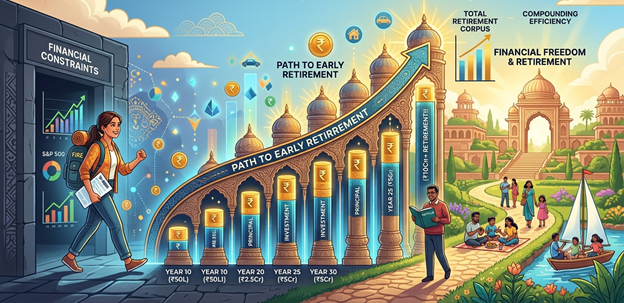
A conceptual illustration of financial independence blending modern compound charts with traditional Indian motifs
Nevertheless, aspiring retirees must navigate specific local friction points. High domestic inflation can gradually erode purchasing power, while the absence of robust state-backed social security means individuals carry total responsibility for their medical and retirement security. Furthermore, strong cultural family obligations—such as supporting extended relatives or managing rising urban healthcare costs—require meticulous contingency planning.
To insulate your Coast FIRE journey against these macro realities, diversification is essential. Combining inflation-beating equity SIPs with sovereign-backed cushions like the Public Provident Fund (PPF), Employees’ Provident Fund (EPF), and comprehensive family health insurance ensures your wealth engine remains robust against economic turbulence.
Real-World Case Study: How Coast FIRE Works in Rupees-Coast FIRE in India
Practical Example 1: Priya, 26, Software Engineer in Bengaluru
- Monthly expenses: ₹50,000 (₹6,00,000 a year)
- Target retirement age: 58
- Target corpus: ₹6,00,000 × 28 = ₹1.68 crore (today’s rupees)
Her Coast FIRE number changes depending on when she reaches it:
| Age | Years to 58 | Coast FIRE number (today’s ₹) |
| 26 | 32 | ~₹30 lakh |
| 30 | 28 | ~₹37.5 lakh |
| 32 | 26 | ~₹42 lakh |
| 35 | 23 | ~₹49 lakh |
| 40 | 18 | ~₹64 lakh |
The number keeps rising as you age because compounding has less time to work. This is why starting early matters so much.
Can Priya reach ₹42 lakh by 32? Suppose she already has ₹8 lakh (EPF, savings, existing mutual funds). At a 5.5% real return, that grows to about ₹11 lakh in six years. She needs roughly ₹31 lakh more, which works out to about ₹36,000 a month (in today’s rupees) for six years.
That’s steep on a ₹50,000-a-month lifestyle, and it’s only realistic for a high earner. If you can’t do it, adjust the date, not the dream. If Priya targets Coast FIRE at 35 instead, the required SIP falls to about ₹26,000 a month. A slightly later coast date makes the plan far more livable.
Her income rises over time too, which is where step-up SIPs come in.
Practical Example 2: Rohan, 35, Starting Late
Rohan didn’t invest in his 20s. He’s 35, spends ₹60,000 a month (₹7.2 lakh a year), wants to retire at 60, and has ₹12 lakh invested.
- Target corpus: ₹7.2 lakh × 28 = ₹2.02 crore
- He decides to coast at 45, which gives him 15 years of compounding after that
- Coast FIRE number at 45: about ₹90 lakh
- His ₹12 lakh grows to about ₹20.5 lakh by then
- The gap of about ₹70 lakh needs roughly ₹44,000 a month for 10 years
That’s a high savings rate, which is why the FAQ below says 35 to 50% for late starters. The good news is that it’s achievable on a rising income. Rohan doesn’t need to start at ₹44,000. He can start lower and raise it every year, as in the next example.
The Step-Up SIP: Your Secret Weapon
Your salary won’t stay flat, so your SIP shouldn’t either.
Say you start a SIP of ₹15,000 a month and raise it by 10% every year, in line with your appraisal:
- Year 1: ₹15,000 a month
- Year 3: ₹18,150 a month
- Year 5: ₹21,960 a month
- Year 8: ₹29,230 a month
You barely feel each increase, because it comes from the raise you were already getting. Over 10 years at 12% nominal, this beats a flat ₹15,000 SIP by a wide margin. Rule of thumb: whenever you get a raise, send at least half of it to your SIP before lifestyle creep gets to it.
Books That Will Sharpen Your Plan
Numbers are only half the battle, and mindset is the other half. These books pair well with this guide:
- The Psychology of Money by Morgan Housel: Why behaviour matters more than IQ in investing. Start here.
- Let’s Talk Money by Monika Halan: One of the best India-specific personal finance books, covering insurance, loans and investing in plain language.
- Your Money or Your Life by Vicki Robin & Joe Dominguez: The classic that shaped the whole FIRE movement. It will change how you think about what money costs in life-energy.
- The Little Book of Common Sense Investing by John C. Bogle: The case for low-cost index funds from the man who popularised them.
Navigating India’s Unique Challenges
FIRE in India is different from the West. We have a lower cost of living and a strong savings culture (households save roughly 30% of income). But there are real friction points:
- High inflation erodes purchasing power faster than in developed economies.
- Limited state social security means medical and retirement security are largely your own job.
- Family obligations (supporting parents, extended relatives, a sibling’s education) are real and deserve a line in your budget.
- Rising healthcare costs can wipe out a corpus overnight without insurance.
Practical Example 3: Stress-Testing Your Plan
Planning for the best case is easy. Planning for the worst is where plans survive. Run Priya’s numbers through three scenarios:
- Base case (5.5% real): needs ₹42 lakh at 32.
- Pessimistic (4.5% real): the coast number jumps to about ₹52 lakh.
- Family-support shock: she spends ₹10,000 a month on parents from age 40. Her annual expenses rise by ₹1.2 lakh, the target corpus by about ₹33.6 lakh, and she needs to adjust her plan accordingly.
If your plan still works under the pessimistic case, you’re in good shape. If it only works under the optimistic one, build in a buffer.
Diversification: Building a Robust Engine
Don’t put everything in equity. A balanced base looks like this:
- Equity SIPs (Nifty 50 index funds, Flexi-Cap funds) for long-term growth
- EPF and PPF as sovereign-backed, tax-efficient stabilisers
- Health insurance for the whole family, plus a term plan if anyone depends on your income
- An emergency fund of 6 months’ expenses in a liquid or savings instrument
Equity may fall 30% or more in a bad year. The defensive layers let you stay invested instead of panic-selling, and staying invested is half the game.
Your 5-Step Roadmap to Coast FIRE
- Audit your expenses. Separate essential costs from discretionary ones. Track 3 months of spending and you’ll find leaks you didn’t know existed.
- Build your defensive shield. Set up the emergency fund plus health and term insurance before chasing returns.
- Design a high-conviction portfolio. Anchor on low-cost index funds, add a Flexi-Cap fund if you like, and keep EPF/PPF as the stable core.
- Activate step-up SIPs. Increase contributions by 10% each year, or half of every raise.
- Protect your mindset. Avoid lifestyle creep, ignore market noise, and check your progress quarterly, not daily.
Frequently Asked Questions
1. Can I achieve Coast FIRE in India if I start investing at 35?
Yes. A smaller starting corpus is needed in your 20s, but at 35 it’s still very achievable if you sustain a savings rate of 35 to 50% for 8 to 10 years using step-up SIPs (see Rohan’s example above).
2. Should I include my primary residence in my Coast FIRE net worth?
No. Your home doesn’t generate cash flow for daily expenses unless you sell it. Count only liquid, compounding financial assets.
3. What happens if I coast and my income drops below my expenses?
Coast FIRE only guarantees your retirement corpus. Your income must still cover current expenses. Plan a lower-stress job or side income that actually pays your bills before you coast.
4. Is 5.5% real return realistic?
It’s a reasonable planning number for a diversified, equity-heavy portfolio over 20+ years, but it’s not guaranteed. Stress-test with 4.5%, as in Example 3.